


2024/10/24
 2026/2/27
visa
How can a Business Manager Visa holder bring family to Japan on a Dependent Visa?

Family members of Business Management visa holders need a ‘Family Residence Visa’ to stay in Japan. Some people may think that they can invite their family members to Japan if they obtain a business management visa. However, obtaining a business management visa does not automatically mean that family members can also live in Japan!
The main points of this article are as follows.
| ✓[Critical Update] As of October 2025, it is a mandatory prerequisite for family sponsorship that the business owned by the supporter meets the new criteria (e.g., a minimum capital of 30 million yen).
✓Even if a business management visa is granted, family members must obtain a separate ‘family residence visa’. ✓Financial support by dependents and proof of family relationship are mandatory for obtaining a family residence visa. ✓If the child is 18 years of age or older, it will be difficult to obtain approval unless the specific necessity of dependency is clearly and thoroughly explained. ✓Under a Dependent Visa, working is generally prohibited. However, by obtaining “Permission to Engage in Activity other than that Permitted under the Status of Residence Previously Granted,” you can work up to 28 hours per week. |
This article provides a detailed overview of the family residence visa, the process of obtaining it and points to note. Make sure you have all the necessary information beforehand so that your family can live in Japan with peace of mind.
1.A visa is also required for family members of business visa holders to stay in the country
When a foreigner establishes a company in Japan and obtains a business management visa, his/her family members (spouse and children) need a ‘family stay visa’ to stay in Japan.
In other words, not only the business administration visa holder himself/herself but also his/her family members need to apply for a separate visa.
Permission is not automatically granted.
This section provides an overview of the family residence visa, the process of obtaining it and the family members who can be invited.
1-1. Introduction: Regarding the Legal Amendment of October 16, 2025
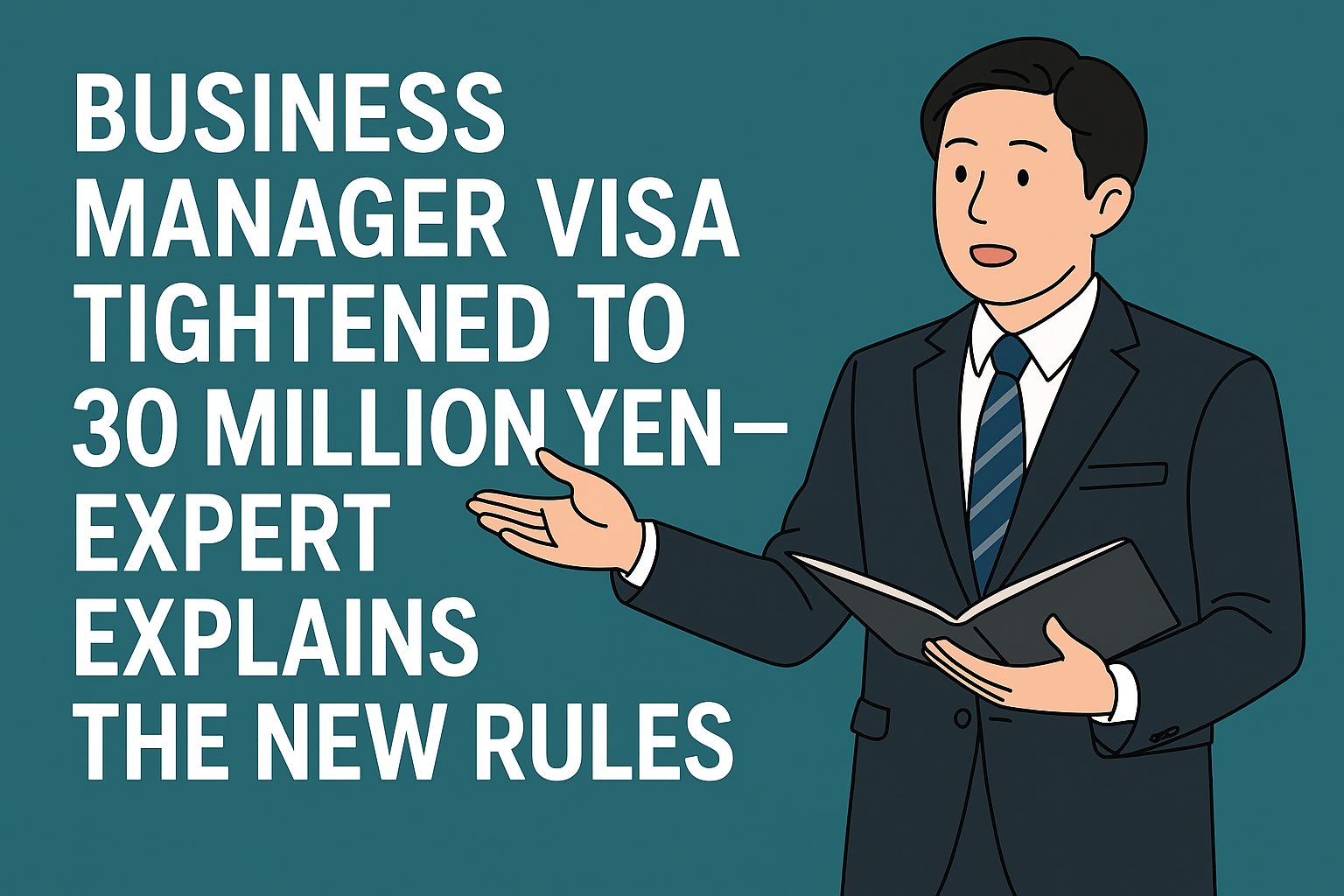
Before reading this article, there is a crucial point that must be understood. On October 16, 2025, the requirements for the “Business Manager” visa—the status held by the supporter—were significantly tightened. It is now mandatory for business owners to meet strict criteria, including a minimum capital of 30 million yen, the employment of at least one full-time staff member, and over three years of management experience.
Therefore, for any business owner planning to sponsor their family, ensuring that you personally clear these high new hurdles is an absolute prerequisite for applying for a Dependent Visa. This article explains the specific requirements for the Dependent Visa itself, based on the assumption that these primary conditions have been met.
Related articles
1-2. What is a family residence visa?
The Family Resident Visa is a status of residence granted to foreign nationals with a work visa (including a Family Resident Visa) who wish to bring their dependent spouse and children to Japan.
For example, in the case of a family of three consisting of a father with a business management visa, a mother who is a housewife and a child of primary schools age, the mother and child can live in Japan with the father by applying for a Family Residence visa. Adopted children of foreigners with a work visa can also apply for a family residence visa in the same way.
However, as a rule, working is not permitted on a family residence visa. If you wish to work part-time, you must obtain a separate ‘Permission to Engage in Activity other than that Permitted under the Status of Residence’.
1-3. How to apply for a family residence visa and required documents
The main steps in obtaining a family residence visa are as follows
| process | Location | correspondent | ||
| (1) | Preparation of application documents | Japan | Foreigners residing in Japan on a work visa
(Invitee) |
|
| (2) | Application for the issuance of a certificate of recognition for a family residence visa | |||
| (3) | Sending a ‘Certificate of Eligibility’ for a family residence visa to family members abroad | |||
| (4) | Visa applications | Apply for a visa with the ‘Certificate of Eligibility’ | Local Japanese embassy or consulate | Spouse/children of foreign nationals |
| Receive a residence card | Airport or municipal office of residence in Japan | |||
(1) [Preparation of application documents]
The required documents are listed below. Other documents may be required depending on the individual circumstances of the applicant, so please check the Immigration and Immigration Management Agency website for details.
- Application form for a certificate of eligibility (1 copy)
- 1 photograph (a photograph meeting the specified standards must be prepared and submitted with the application)
- Return envelope (a self-addressed, stamped envelope with the required amount of postage stamps (for registered mail) attached) 1 copy
- Documents certifying the relationship between the applicant and his/her dependants One of the following
- A copy of the family register
- Certificate of acceptance of marriage registration 1 copy
- Marriage certificate (copy) 1 copy
- Birth certificate (copy) 1 copy
- Documents equivalent to (1) to (4) above, as appropriate
- Copy of the dependent’s residence card or passport 1 copy
- Document certifying the dependent’s occupation and income
(2) [Application for the issuance of a certificate of recognition of a family residence visa]
The first step is for the person holding a work visa in Japan (the inviting party) to apply for a certificate of eligibility for ‘family stay’ for their spouse or children at the regional immigration office.
The examination of this application usually takes between one and three months, but may vary depending on the individual case. If there are any deficiencies in the documents under examination, you may be asked to amend them or submit additional materials, so make sure you respond promptly when you are contacted.
(3) [Sending the certificate of recognition of the family residence visa to family members abroad]
You will be informed of the result within one to three months of your application, and if approved, you will be issued with a ‘ Certificate of Eligibility ’. This certificate is a necessary document for obtaining a visa. The Certificate of Eligibility is sent to the spouse and children in the home country.
Upon receiving the Certificate of Eligibility, the spouse and children residing in the home country take the Certificate of Eligibility to the local Japanese embassy or consulate and apply for a visa. In some countries, the application must be made through an agency, so it is advisable to check this beforehand. Once the examination is completed, the visa will be affixed to the passport and returned to you. You will then book a flight ticket and come to Japan to complete immigration procedures.
(4) [Receipt of residence card]
When a foreign spouse enters Japan for the first time, a residence card is issued at seven airports – New Chitose Airport, Narita Airport, Haneda Airport, Chubu International Airport, Kansai Airport, Hiroshima Airport and Fukuoka Airport . After receiving your residence card, you must register at the municipal office of your place of residence within 14 days.
If you enter the country from an airport other than these seven airports, an entry relating to your residence will be made in your passport, which will temporarily serve as your residence card. The residence card is officially issued by post within a few days of registering your residence at the municipal office of your place of residence within 14 days of entering the country.
1-4.Scope of family members who can be invited on a business management visa
The scope of family members that a Business Management Visa holder can invite to Japan is limited to spouses and children of legally valid marriages.
With regard to spouses, only those whose marital status has been formally recognised are eligible. Divorced or bereaved former spouses, common-law partners and partners in same-sex marriages are therefore not included.
With regard to children, it does not matter whether they are biological or adopted. Specifically, legitimate children, recognised illegitimate children, ordinary adopted children and specially adopted children are covered.
On the other hand, relatives such as parents and siblings are not eligible for a family residence visa. If you wish to invite these relatives to Japan, you will need to consider a short-stay visa or similar.

2. Family residence visa requirements
In order to obtain a family residence visa, a number of important requirements must be met. These requirements are intended to ensure that family members can lead a stable life in Japan and to prevent unauthorised entry. The main requirements and their details are explained here.
2-1. Spouse and children actually receive support
An important requirement of the family residence visa is that the spouse or child must actually be dependent. It is not just a question of having a family relationship, but also of being financially dependent on the dependent.
In the case of a spouse, financial dependence must be established on the basis of cohabitation. In the case of children, they must be under the care and maintenance of their dependants. Make sure you have the relevant documents to prove the fact of dependency.
However, if the dependent has a higher annual income than the dependent or is financially independent, he or she may not be eligible for a family residence visa.
Also, if the child is over 18 years of age, the dependent relationship is less likely to be recognised. Evidence must be provided regarding the fact that the child is dependent on a parent, e.g. student status.
2-2. The supporter possesses both “business stability” and “personal financial capability” sufficient to support all family members.
The most critical factor in the screening process for a Dependent Visa is whether the supporter, as a business owner, possesses sufficient financial capability to support the entire family. Following the 2025 legal amendments, the criteria for evaluating this financial strength are now scrutinized more rigorously from the following two perspectives.
(1) Stability and continuity of the business itself (the company’s financial strength)
Currently, following the legal amendments, the most critical indicator for assessing a supporter’s financial capability is whether the business they manage satisfies the new criteria for the Business Manager visa.
The following points will be strictly scrutinized:
- Whether the capital is 30 million yen or more
- Whether at least one full-time staff member is employed
- Whether the business is profitable and operated stably
If the supporter’s business foundation is judged to be unstable, it raises serious doubts about their ability to support their family consistently—no matter how high their individual executive compensation may be. This significantly increases the risk of the application being rejected.
(2) Personal financial capability of the supporter (Executive compensation)
Assuming the business stability mentioned above is met, the executive compensation received by the supporter as an individual is also subject to screening. This is to ensure that the family can maintain a stable life in Japan without relying on public assistance.
While there is no specific fixed amount required by law, generally, a minimum annual income of 2.5 to 3 million yen is considered necessary for the supporter. Furthermore, an additional 700,000 to 800,000 yen is typically expected for each additional family member being sponsored.
This financial capability must be proven through “Taxation Certificates” (Kazei Shomeisho) and “Tax Payment Certificates” (Nozei Shomeisho) issued by the local municipality. It is crucial to demonstrate both a stable income and the consistent fulfillment of tax obligations.
In conclusion, under the new system, it has become increasingly difficult to sponsor family members unless both of the following are proven: not only that the business owner receives sufficient executive compensation, but also that the company paying that compensation possesses a stable and robust business foundation that meets the new rigorous standards.
Marital status is also looked at in terms of whether they live together
The Immigration Bureau of Japan places importance on the fact that the applicant is ‘living together’ when determining ‘marital status’ in the examination of family residence visas.
If they do not live together, the visa will not be refused in all cases, but they may require a satisfactory explanation as to why.
For example, it may be assumed that one of the children is living alone because it is difficult for the child to change schools, or that the child has started living on his or her own, for example, to go to university.
2-3. Can prove a family relationship
To apply for a family residence visa, documents proving the family relationship between the dependent and the applicant are required. This includes official documents such as the Japanese equivalent of the family register, marriage certificate and birth certificate.
These documents must be prepared and submitted in the home country. If these certificates are in a foreign language, a Japanese translation must be provided.
3. Precautions when applying for a family residence visa
There are many considerations when applying for a family residence visa. The age of the children, the timing of inviting family members and the cost of living together are often issues. Specific precautions are explained below.
3-1. Children are more difficult to obtain permission depending on their age
When applying for a family residence visa, be aware of the age of the child: if the child is over 18 years old, it is more difficult to be granted a visa.
This is because the Immigration Bureau suspects that the intention is to ‘work in Japan’ rather than ‘be dependent on their parents’.
Therefore, it is necessary to explain clearly and reasonably why you are bringing them to Japan for a family stay. Even if the child is under 18 years of age, the applicant is required to show a justifiable reason for bringing the child to Japan and an educational plan for the future.
It is also important to note that if you switch to a student visa when your child enters university or vocational school, you will not be able to return to a family stay visa unless you find a job after graduation.
3-2.Reasonable grounds are required if there is a difference in the timing of the call within the family.
When applying for a family residence visa, it is possible for the business manager with a business management visa to come to Japan first and then invite the spouse and children later, but there must be a reasonable reason if the family members are invited sequentially.
If only the couple comes first and then the children are called several years later, the immigration authorities may question why the children have been brought up by someone else in their home country until now, or why they need to be brought up in Japan now.
It is therefore important to be prepared to explain in detail what the circumstances are for calling the child. For example, you are required to explain why the immigration authorities are satisfied, for example, by stating that the manager has established a good basis for living in Japan and that an educational environment has been established.
3-3.Not permitted on the premise of working with a family member to make ends meet
The family residence visa is a residence status for family members who are dependent on the foreign business owner, and the business owner must be able to support his or her family independently at the time of application.
For example, if the initial income from opening the business is not sufficient to cover living expenses and the business owner wishes to make a living by having his/her spouse or children work part-time, this will not meet the visa requirements and is likely to be denied.
The family residence visa is based on the premise that the dependent person is able to meet all living expenses in Japan, so it is not permitted for the dependent person to work together to meet living expenses.
Furthermore, if a foreigner with a family stay visa wishes to work, he/she must obtain a ‘Permit to Engage in Activity other than that Permitted under the Status of Residence’. This permit allows them to work part-time, but the working hours are limited to 28 hours per week. In addition, it is not possible to work in the entertainment industry.
Including licences
If a family residence visa holder wishes to work, the working hours must not exceed 28 hours per week and the ‘activity must not be in the entertainment business’. If these conditions are met, a ‘blanket permit’ is granted, which does not specify the place of work or the nature of the work.
In order to obtain a blanket permit, it is important that the applicant’s current activity of residence status is not affected. It is also required that the activities related to the application do not violate the law and that the applicant is of good conduct.
This allows foreigners with a family residence visa to work legally. However, activities related to the sex industry are not permitted.
Individual permission
f the conditions for a blanket permit are not met, an ‘individual permit’ is granted, which allows the individual to work for a specific place of work or job description. To obtain this permit, the following requirements must be met.
First, the requirements for a permit to engage in activities outside the scope of the qualification must be met. Furthermore, it is important that the duration of the activity engaged in does not exceed the majority of the period of stay based on the status of residence. If the activity is deemed to be a substantial change in the purpose of stay, a change of status procedure is required.
When applying, documentation must be provided on the nature of the activity, the hours of activity and the remuneration. It is also important to take care not to deviate from the requirements for support.
Related articles
4. Summary
This article provides an overview of the family residence visa for business management visa holders who bring their family members to Japan, its requirements and points to note when applying for the visa. The contents are summarised as follows.
| ✓[Critical Update] As of October 2025, it is a mandatory prerequisite for family sponsorship that the business owned by the supporter meets the new criteria (e.g., a minimum capital of 30 million yen).
✓Even if a business management visa is granted, family members must obtain a separate ‘family residence visa’. ✓Financial support by dependents and proof of family relationship are mandatory for obtaining a family residence visa. ✓If the child is 18 years of age or older, it will be difficult to obtain approval unless the specific necessity of dependency is clearly and thoroughly explained. ✓Under a Dependent Visa, working is generally prohibited. However, by obtaining “Permission to Engage in Activity other than that Permitted under the Status of Residence Previously Granted,” you can work up to 28 hours per week. |
The family residence visa is an important visa for foreigners who have obtained a business management visa to live together with their family in Japan. There are several requirements to clear when applying for a Family Resident Visa, such as dependency requirements and proof of family relations.
Make sure you prepare well in advance so that you can smoothly bring your family to Japan.
If you are unsure about the procedures and requirements for a family residence visa, consider consulting a specialist administrative scrivener.
Article supervision

Representative Judicial Scrivener and Administrative Scrivener, Legal Estate Office
Ryo Saito
¥A judicial scrivener with over 10 years of practical experience and more than 5,000 consultation cases. Expert in a wide range of fields including laws and contracts related to overseas inheritance and business, as well as compliance advice. Recently, there has been an increase in international inheritance cases, particularly where some parties reside abroad, and vigorous efforts are being made to address these issues.
Our Key Accomplishments:
We handle over 100 company formations and real estate/corporate registrations annually.
We have assisted clients from over 20 countries, including the United States, China, and South Korea, with real estate transactions and business startups.
Our experience spans a wide range of industries, such as IT, food and beverage, trade, and consulting.
As certified legal professionals ("Shiho-shoshi" and "Gyosei-shoshi"), our strength lies in providing one-stop support for everything from the initial company registration and business visa applications to subsequent changes in company officers and capital increases. Please feel free to contact us for a consultation.

